
"Artificial intelligence," "automation"… Behind these buzzwords lies a very concrete question for a business owner: what does it actually change in my day-to-day? The answer comes down to one simple idea. Used well, AI doesn't replace your expertise: it frees up your time by taking on the repetitive tasks that add no value. But you first need to know which automations we're talking about — and, above all, how they are implemented. Because on that last point there are two schools of thought, and they offer very different guarantees.
Built into your website, not plugged into a third-party tool
Most of the "AI automations" being offered today rely on external platforms such as Make, Zapier or n8n: you assemble "workflows" that pass your data from one service to another. It's quick to set up, but it comes at a price — one more monthly subscription, dependence on a tool you don't control, and customer data flowing between several providers, often hosted outside Switzerland.
Our approach is the opposite: the automations are coded directly into your website, using the AI model (LLM) of your choice. No third-party tool, no external subscription (apart from the LLM), no data slipping off to a service you didn't choose. The feature lives inside your website, like everything else: it's yours, it lasts, and it's tailored to your profession. Here's what that makes possible, in concrete terms — with a use case for each.
A chatbot that only says what it knows
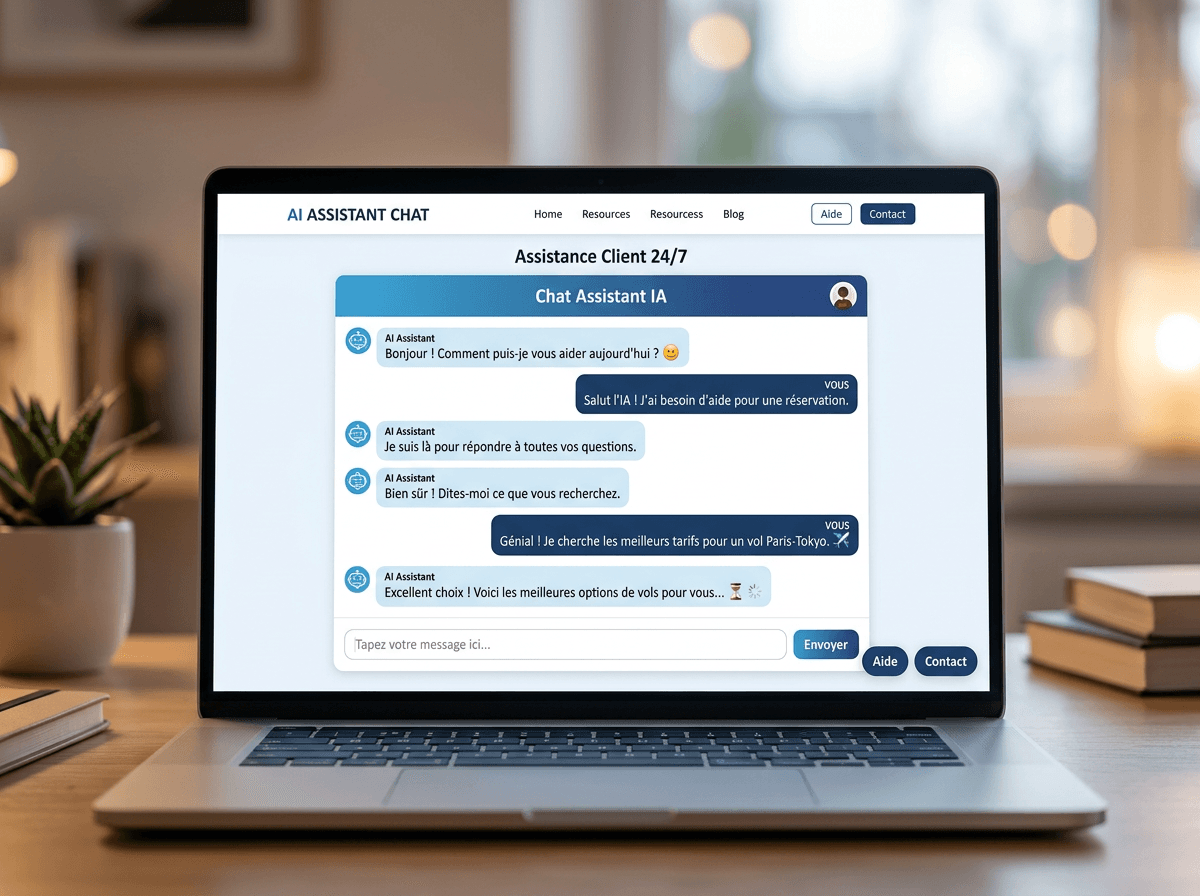
The most visible use: a conversational assistant built into your website, answering visitors around the clock. Trained solely on your website's content, it provides information about your services, your opening hours or how a first appointment unfolds — and, when in doubt, invites people to contact you rather than inventing an answer. It works evenings and weekends, precisely when a potential client takes the time to look for a provider.
Use case: a practice receives the same questions every week ("are you taking on new clients?", "which documents should I prepare?"). The chatbot answers them instantly, and the team only handles the requests that truly fall outside the usual scope.
Smart forms that qualify your enquiries
Rather than a passive contact form, a smart form gathers the key details upfront — need, budget, deadline, location — and only surfaces the requests that are genuinely relevant, already structured. You no longer waste time on enquiries that go nowhere, and you welcome the good ones with a file that's already prepared.
Use case: a tradesperson receives a quote request. The form has already collected the type of project, the surface area, the desired timeframe and a few photos. From the very first read, the tradesperson knows whether they can take it on — and their proposal goes out the same day.
Document extraction: from paperwork to database
A PDF, an invoice, a scanned contract: instead of re-entering the information by hand, your website reads them and automatically extracts the useful data — name, company, phone number, amounts, dates, deadlines — to file it straight into your database or your spreadsheet.
Use case: an accounting firm receives dozens of supplier invoices every month. Each document uploaded to a secure space is read automatically; the supplier, the net/gross amounts and the due date are extracted and recorded, ready for the accounts. No more re-keying, no more copying errors.
A recommendation engine: the right content at the right moment
Automatically offering each visitor what interests them: similar properties, complementary products, related articles. The engine analyses the context and suggests the most relevant next step, with no manual intervention.
Use case: on an estate agency's website, a visitor views an apartment. The site immediately shows them three comparable properties and an estimate range for their own home — enough to keep them there longer and prompt them to get in touch.
Searching your document library
Your internal documents — templates, procedures, technical sheets — become searchable in natural language. You ask a question, the AI answers by citing the relevant passages, without you having to dig through folders.
Use case: in a law firm, all the contract templates are indexed. A colleague asks for "the non-compete clause for a permanent management contract"; the tool finds the right template and highlights the exact passage. What used to take ten minutes of searching now takes a few seconds.
File analysis: summaries, anomalies, tables
Upload a file, get a reading of it. The AI summarises, spots anomalies, calculates and proposes visualisations — a first pass of analysis prepared for you, with nothing left to do but validate it.
Use case: a manager imports the CSV export of the month's sales. Within seconds, they get a breakdown of expenditure by category, a flag on two unusual amounts and charts ready to present in a meeting.
The safeguard: your data stays under your control
Because these features are coded into your website and not delegated to an external platform, you keep control over where your data goes. Together we choose the AI model — including European or sovereign solutions — and we define precisely what may be processed: sensitive data is never sent to a public AI service. That's the condition for AI that is compatible with the nFADP and the GDPR, and with the trust your clients place in you. Where your data is located is, in fact, closely tied to your choice of technology, a topic we cover in Webflow or Next.js: which technology for your website?.
Where to start?
There's no need to automate everything at once. The right approach is gradual: you start with a high-impact, low-risk building block — a chatbot that lightens your front desk, or a form that qualifies your enquiries — you measure the time saved, then you expand. At every step, a single question should guide the choice: does this tool free up time for my clients, without ever compromising their confidentiality?
AI won't replace what makes your business valuable: your judgement, your expertise, the trust you inspire. But intelligently built into your website — coded to measure, with no dependence on a third-party tool — it frees up your time. Automating the tedious so you can refocus on what matters: that's exactly what we build. Let's talk about what, in your day-to-day, would be worth automating.